


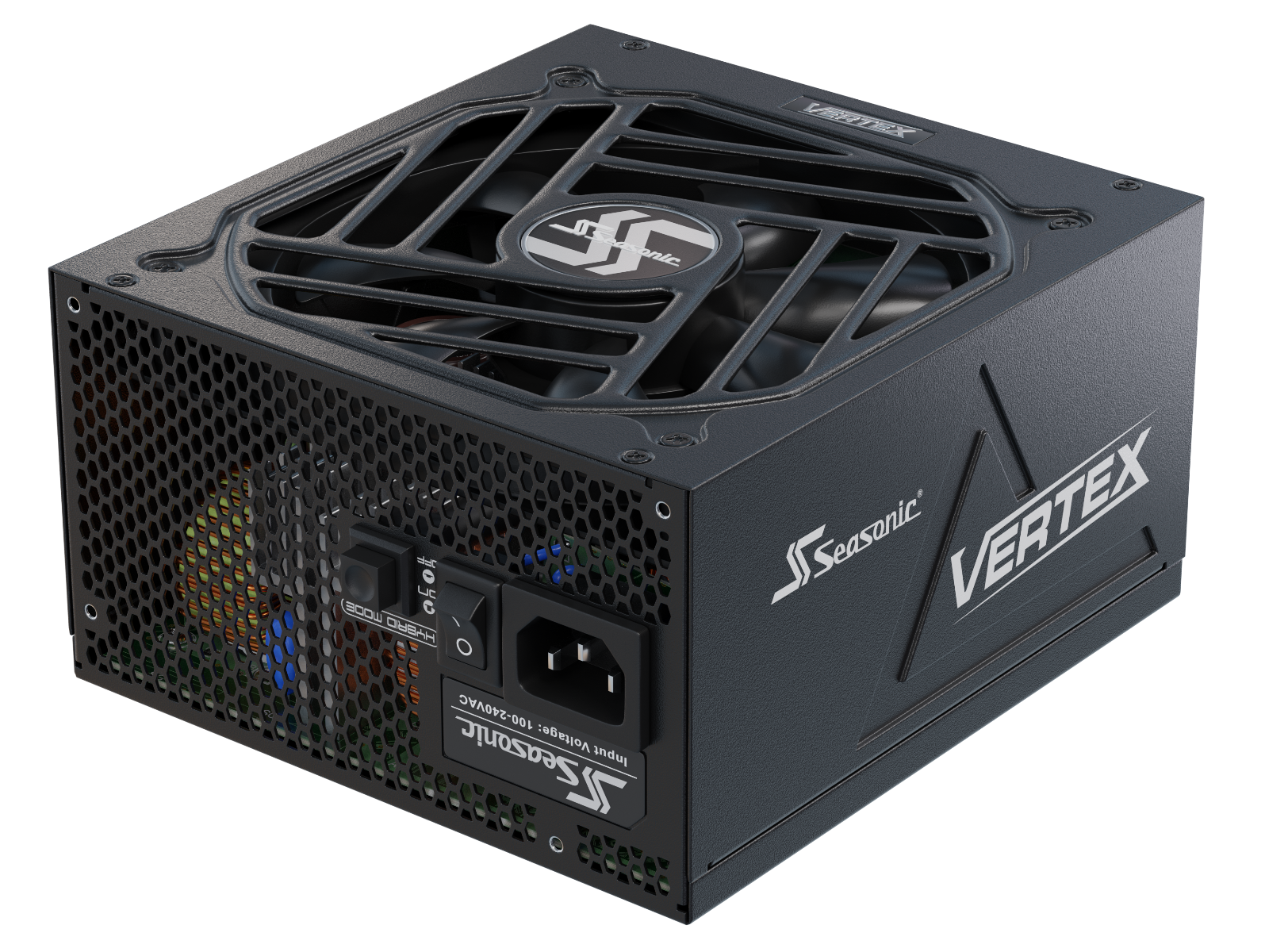




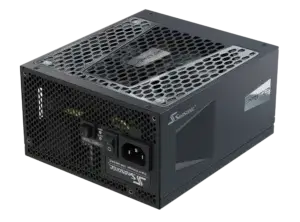


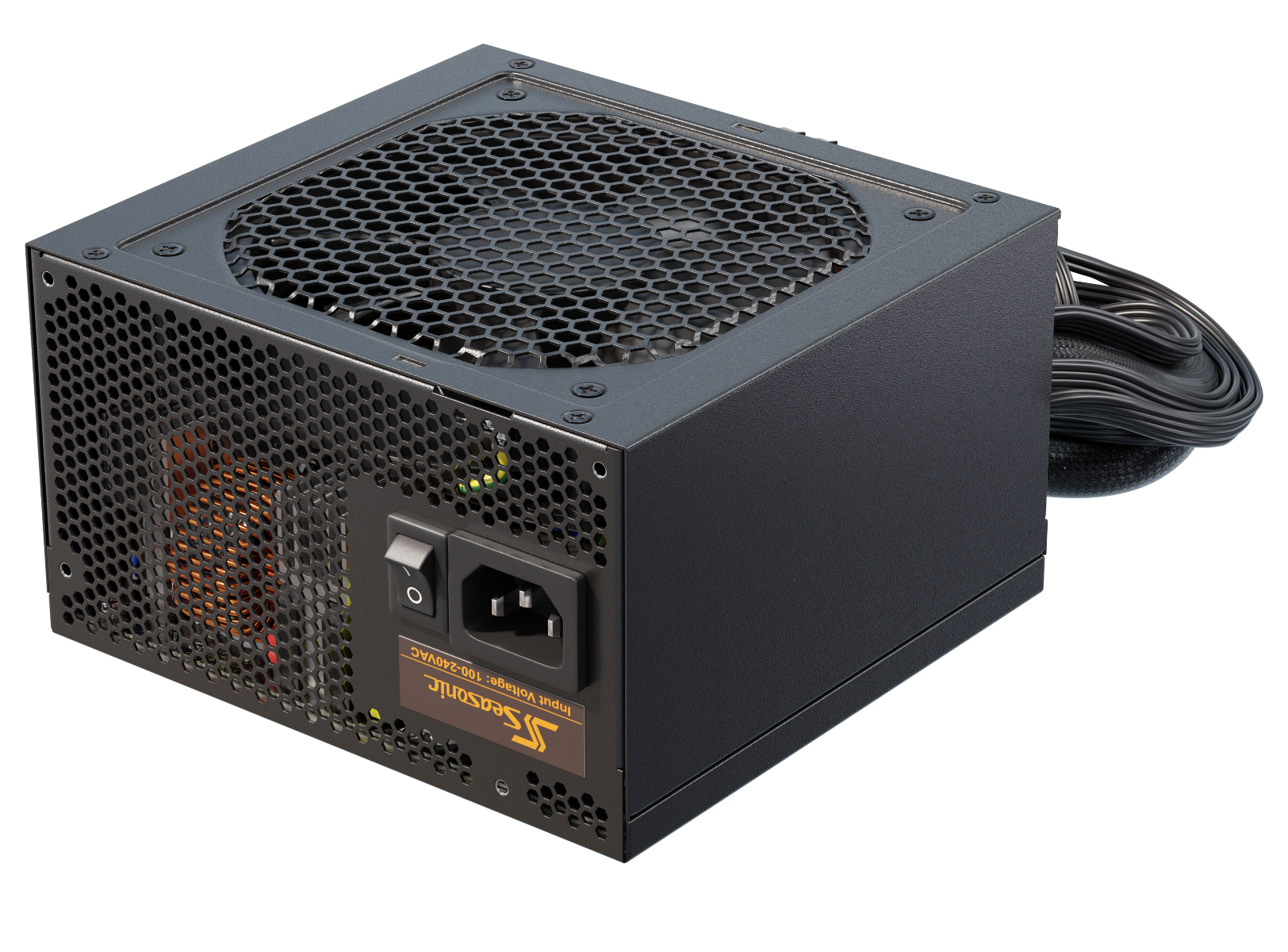
La eficiencia siempre ha sido un objetivo principal en el diseño de fuentes de alimentación, ya que la pérdida durante la conversión de energía impone costos adicionales en general.
El poder de los grandes números
In 2004, the US EPA’s ENERGY STAR programme estimated around 10 billion power supplies in use worldwide — across computers, servers, printers, televisions, phones and more.
Efficiency back then was poor. The same assessment found many designs converting only 30 to 60% of the power they drew, and the prevailing industry design guide for PC power supplies required just 70% efficiency at 50% load.
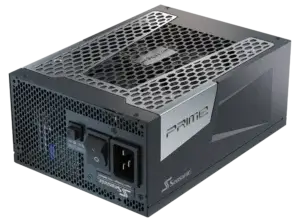
Certified designs today are in a different class. 80 PLUS® Titanium requires 94% at 50% load on 115 V, and the newer Ruby tier 95%. Cybenetics Diamond, which averages efficiency across the full load range rather than fixed points, requires 95% or higher on 230 V. Seasonic’s PRIME ENTERPRISE RX-1600 is the first ATX power supply certified 80 PLUS® Ruby at 115 V and 230 V.
The historical 70% design-guide requirement and today’s 95% Ruby certification threshold illustrate the difference between those requirements at 50% load. They do not represent the average efficiency of all power supplies in use. For the same DC output power, a more efficient power supply draws less electricity from the wall and loses less energy as heat.
La historia de las certificaciones
Until the early 2000s, power supplies had no efficiency certification, and it was not until 2004 that the first initiative to create an efficiency standard emerged.
The 80 PLUS® program was created in 2004 by Ecos Consulting, an energy efficiency firm, and is today administered by CLEAResult, which acquired the program through Ecos’s successor company.
Sea Sonic partnered with Ecos Consulting at the time to work out uniform efficiency standards, and in 2005 became the first manufacturer to bring the world’s first 80 PLUS® certified PC power supply to market (the Seasonic SS-400HT). Since then, 80 PLUS® certified power supplies have become a de facto component in PC systems.
Entendiendo la eficiencia
La certificación de eficiencia ayuda a los consumidores a saber qué tan eficiente es el suministro de energía.
El porcentaje de eficiencia se obtiene dividiendo la potencia de salida entre la potencia de entrada; cuanto mayor sea este porcentaje, más eficiente será la fuente de alimentación. La potencia de entrada perdida en la conversión se transforma en calor.
Higher-efficiency power supplies often require more advanced designs and components. However, an 80 PLUS® rating specifically certifies energy efficiency, not overall build quality. During certification, the power supply is tested at several load levels, including 100% of its rated output, to verify its efficiency under the defined test conditions.
Cybenetics
Cybenetics Es una empresa de pruebas y certificación de hardware para PC. Se fundó con la intención de revolucionar la forma en que se prueban y comparan las fuentes de alimentación para ofrecer a los usuarios finales una visión más clara de los productos de alimentación que compran para sus sistemas.
La importancia de las mediciones
The basic test methodology is that Cybenetics doesn’t take only three or four measurements to define the efficiency or noise output of a PSU. Instead, Cybenetics applies more than 1,450 different load combinations, from minimal to full load, and calculates the average efficiency and noise readings that determine the PSU’s efficiency and noise ratings.
This provides Seasonic with a complete operational map of the PSU, allowing us to evaluate not only efficiency and noise, but also voltage regulation, ripple, and other important performance data.
| Niveles de eficiencia (entradas de 115 V) | Eficiencia (1) (2) | Pf (3) | Eficiencia 5Vsb (1) (3) (4) | Poder vampírico (3) |
|---|---|---|---|---|
 Diamante Diamante | ≥93% overall efficiency | ≥0.985 | >79% | <0.10 W |
 Titanium Titanium | ≥91% & <93% overall efficiency | ≥0.980 | >77% | <0.13 W |
 Platinum Platinum | ≥89% & <91% overall efficiency | ≥0.975 | >76% | <0.16 W |
 Gold Gold | ≥87% & <89% overall efficiency | ≥0.970 | >75% | <0.19 W |
 Plata Plata | ≥85% & <87% overall efficiency | ≥0.960 | >73% | <0.22 W |
 Bronce Bronce | ≥82% & <85% overall efficiency | ≥0.950 | >71% | <0.25 W |
| Efficiency Levels (230V inputs) | Eficiencia (1) (2) | Pf (3) | Eficiencia 5Vsb (1) (3) (4) | Poder vampírico (3) |
|---|---|---|---|---|
| Diamante | ≥95% overall efficiency | ≥0.950 | >78% | <0.12 W |
| Titanium | ≥93% & <95% overall efficiency | ≥0.940 | >76% | <0.15 W |
| Platinum | ≥91% & <93% overall efficiency | ≥0.935 | >75% | <0.18 W |
| Gold | ≥89% & <91% overall efficiency | ≥0.930 | >74% | <0.20 W |
| Plata | ≥87% & <89% overall efficiency | ≥0.920 | >72% | <0.23 W |
| Bronce | ≥84% & <87% overall efficiency | ≥0.910 | >70% | <0.25 W |
Cybenetics Utiliza una metodología integral y moderna
- Measurements across a wide range of load combinations
- High ambient temperature
- Mediciones de 5VSB
- Mediciones del poder de los vampiros
- Informes modernos del equipo
- Insignias de eficiencia correctas
80 PLUS ®
80 PLUS® offers seven different efficiency certifications
| 80 PLUS Proceso de dar un título | 115 V interno no redundante | ||||
|---|---|---|---|---|---|
| 80 PLUS Proceso de dar un título | 5% | 10% | 20% | 50% | 100% |
 80 PLUS 80 PLUS | - | - | 80% | 80% | 80% PFC ≥ 0.90 |
 80 PLUS Bronce 80 PLUS Bronce | - | - | 82% | 85% PFC ≥ 0.90 | 82% |
 80 PLUS Plata 80 PLUS Plata | - | - | 85% | 88% PFC ≥ 0.90 | 85% |
 80 PLUS Gold 80 PLUS Gold | - | - | 87% | 90% PFC ≥ 0.90 | 87% |
 80 PLUS Platinum 80 PLUS Platinum | - | - | 90% | 92% PFC ≥ 0.95 | 89% |
 80 PLUS Titanium 80 PLUS Titanium | - | 90% | 92% PFC ≥ 0.95 | 94% | 90% |
 80 PLUS Ruby 80 PLUS Ruby | 85% | 91% | 93% PFC ≥ 0.95 | 95% | 91% |
| 80 PLUS Proceso de dar un título | 230 V interno no redundante | ||||
|---|---|---|---|---|---|
| 80 PLUS Proceso de dar un título | 5% | 10% | 20% | 50% | 100% |
| 80 PLUS | - | - | 82% | 85% PFC ≥ 0.90 | 82% |
| 80 PLUS Bronce | - | - | 85% | 88% PFC ≥ 0.90 | 85% |
| 80 PLUS Plata | - | - | 87% | 90% PFC ≥ 0.90 | 87% |
| 80 PLUS Gold | - | - | 90% | 92% PFC ≥ 0.90 | 89% |
| 80 PLUS Platinum | - | - | 92% | 94% PFC ≥ 0.95 | 90% |
| 80 PLUS Titanium | - | 90% | 93% PFC ≥ 0.95 | 95% | 91% |
| 80 PLUS Ruby | 85% | 91% | 94% PFC ≥ 0.95 | 96% | 92% |