


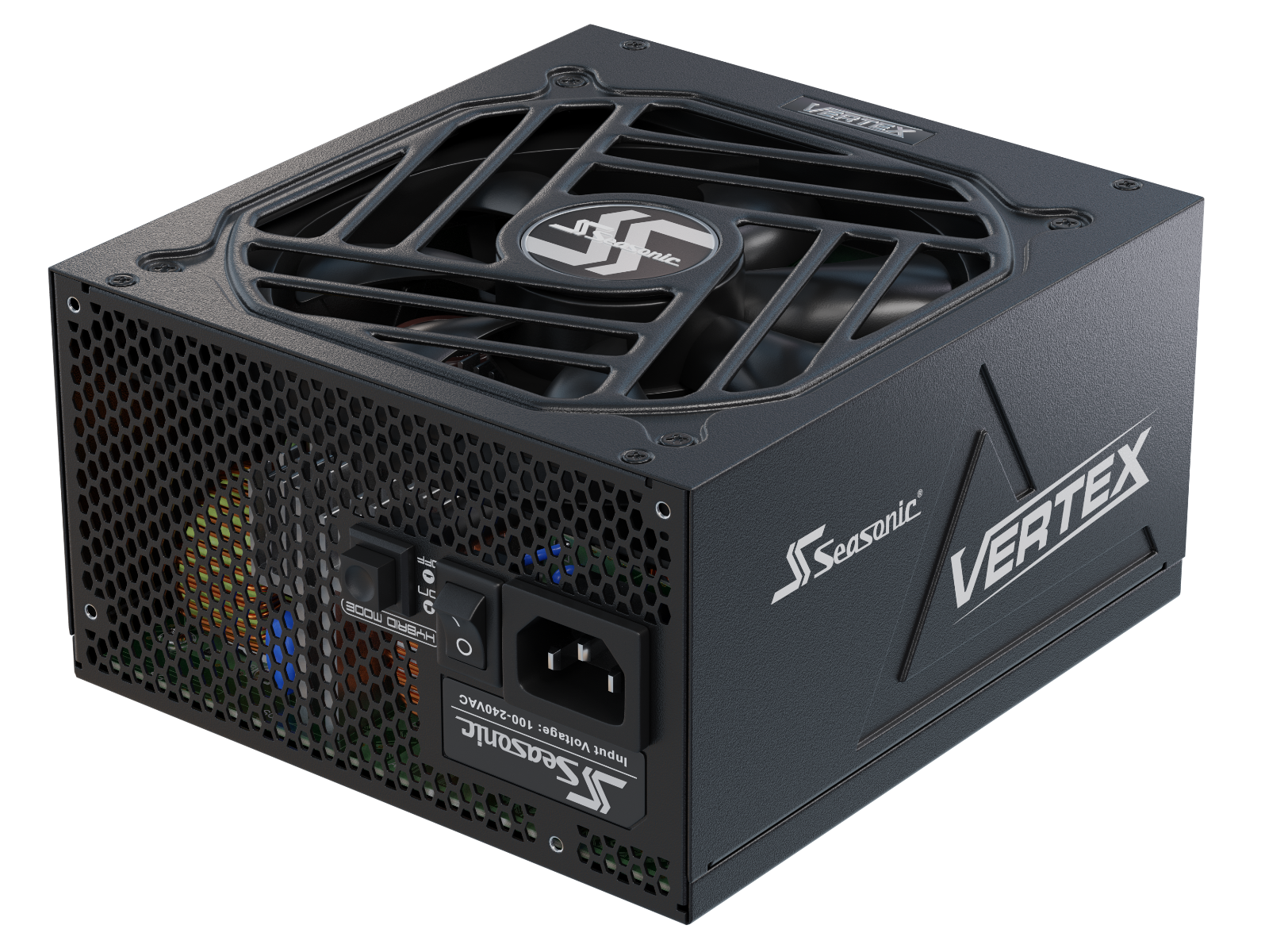




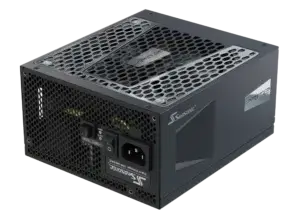


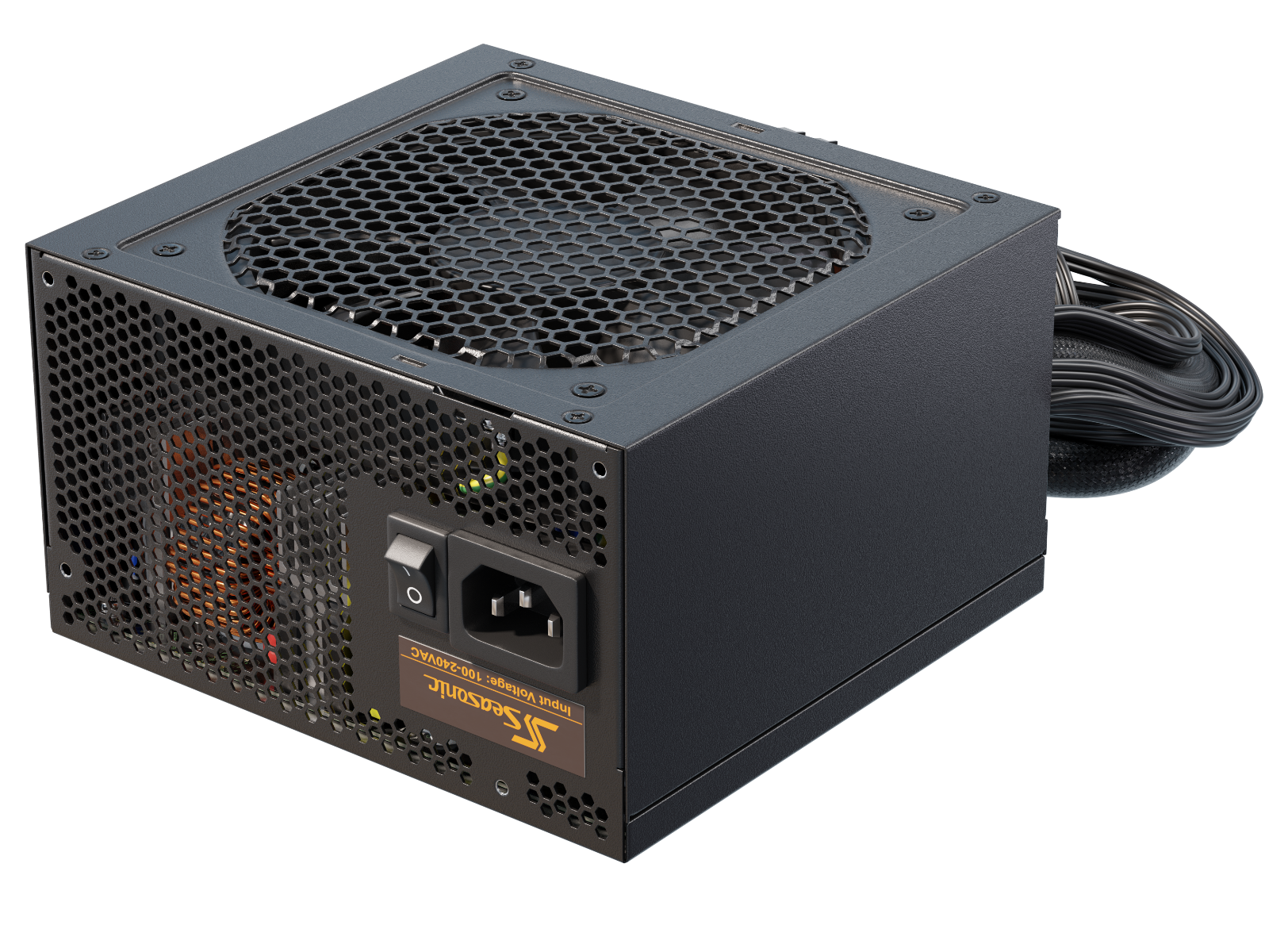


Quiet PC operation depends on the power supply’s cooling system. Here, we explain how our Hybrid Mode has evolved across PSU generations and how PWM regulation differs from hysteresis. We also look at what these controls mean for everyday fan behavior, alongside the roles of FDB fans and OptiSink™.
What are Seasonic hybrid power supplies?
Our hybrid power supplies are models with fan control that combine passive and active cooling. Seasonic Hybrid Mode technology allows the fan to stop when the need for forced airflow is low and to start when operating conditions require additional heat dissipation. The power supply continues to power the computer’s components regardless of whether the fan is spinning or not. Thus, the term “hybrid” in this context specifically describes the cooling mechanism.
Fan behavior is determined by load and temperature. In compatible models, the controller supports Fanless Mode, Silent Mode, and Cooling Mode. This way, cooling is adapted to current conditions and reduces unnecessary fan operation.
In models with a switch, the user can choose between hybrid control and continuous fan operation. For example, our FOCUS PLUS models offer this choice. Leaving the button on the power supply’s rear panel unpressed enables Fanless Mode, while pressing it ensures the fan runs even under light load. Check the switch position according to your device’s manual.
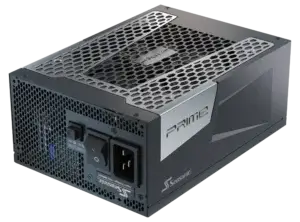
Hybrid models should also be distinguished from PRIME Fanless models. In fully fanless power supplies, the fan is structurally absent, and heat is dissipated passively. In a hybrid unit, the fan is present and automatically engages for cooling. Therefore, the ability to operate without the fan spinning does not mean that the device will remain in that state under any load.
We were the first brand to bring Hybrid Mode to a retail power supply with the launch of the X-Series in late 2009. By combining fanless operation at low cooling demand with active cooling when needed, we introduced an approach that has since become widely adopted across the PC power supply industry. We have continued to refine this technology through subsequent generations of fan control.
Silent cooling technologies
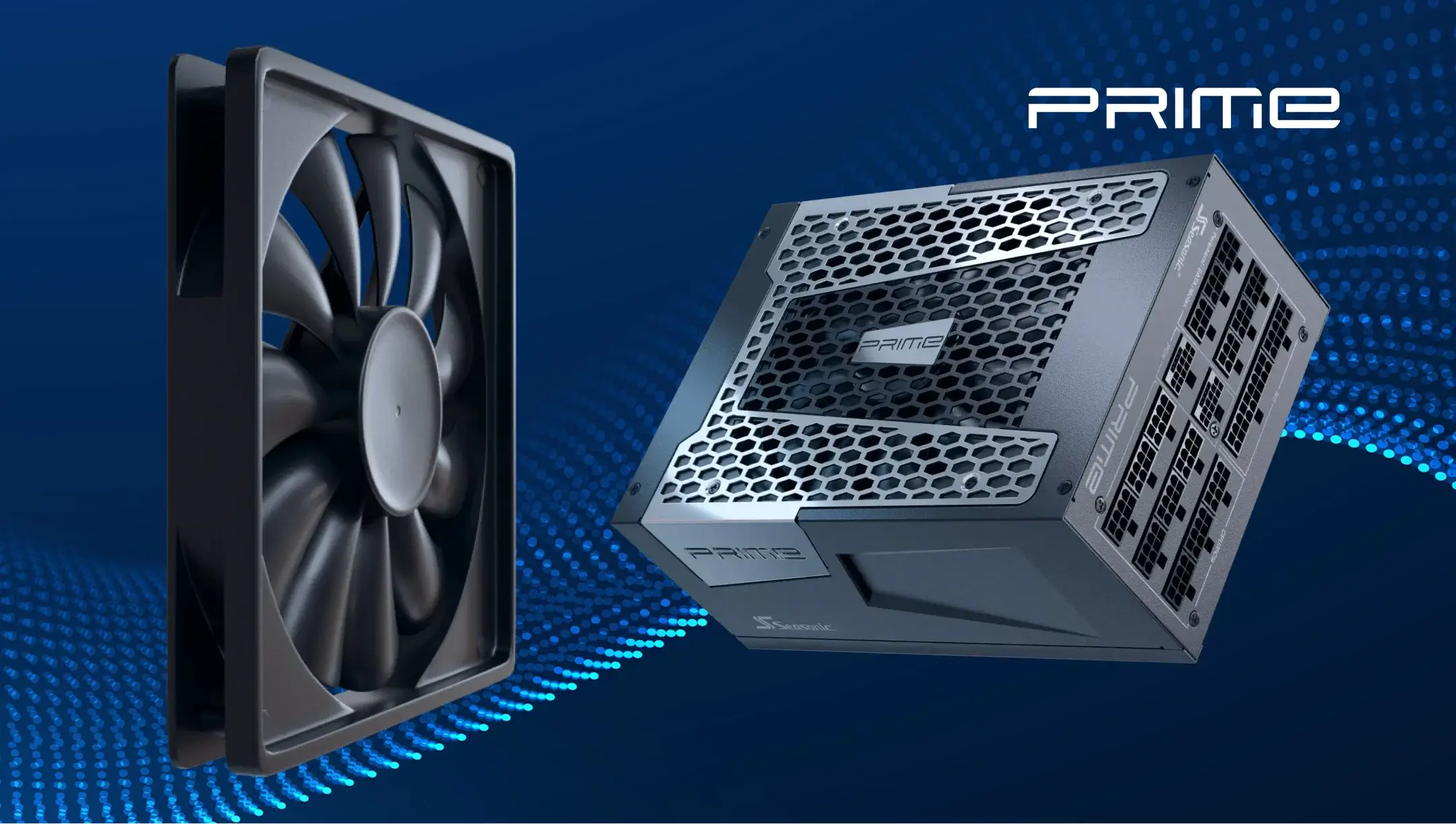
The PSU’s quiet operation depends on how much heat it generates, how efficiently it dissipates that heat, and how it controls the fan. At Seasonic, we combine these factors when designing every power supply unit. High electrical conversion efficiency reduces heat loss for a given output power. Consequently, the cooling system needs to dissipate less heat.
Seasonic Hybrid Mode stops the fan when additional forced cooling is not needed. When active cooling is required, the bearing design and control settings are crucial. A number of models use FDB fans, in which lubricant helps reduce friction and vibration. Combining such a fan with automatic speed control allows the cooling intensity to be adjusted to the power supply’s needs.
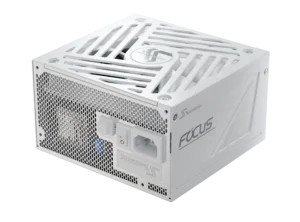
Our general guidance for bottom-mounted power supplies with Hybrid Mode enabled recommends orienting the ventilation cover upward, toward the motherboard. This position helps hot air escape when the fan is idle. However, the OptiSink™ design in the FOCUS GX ATX 3.1 permits installation in any orientation.
Thus, quiet operation is achieved through the interplay of electrical efficiency, thermal design, and fan control. For the user, this means that the entire power supply should be evaluated in conjunction with its installation conditions. The mere presence of a Hybrid button does not determine the temperature, fan speed, or noise level in a specific computer.
OptiSink™ in Seasonic hybrid power supplies
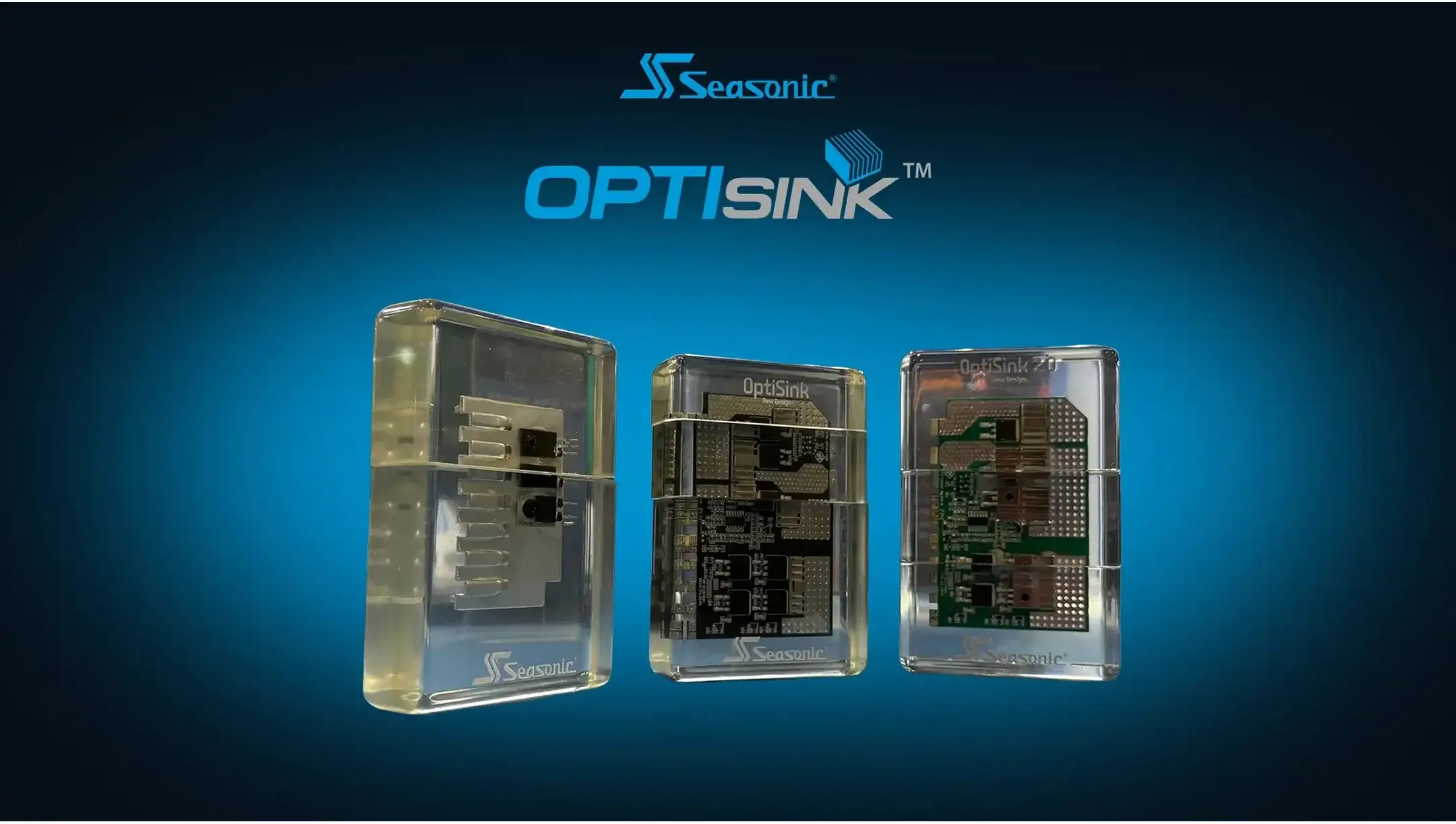
OptiSink™ is a heat dissipation design developed by our engineers that encompasses the printed circuit board layout, the power components placement, and their mounting method. Its purpose is to transfer heat more efficiently and improve airflow inside the unit. This technology complements fan control by creating better conditions for the components’ cooling.
Seasonic OptiSink™ technology can provide up to 48% more internal space compared to the previous generation of designs. Thermal conductivity at the mounting interface can be up to eight times that of thermal-pad mounting. These figures reflect design changes. They should not be interpreted as an eightfold reduction in the entire unit temperature, fan noise, or power consumption.
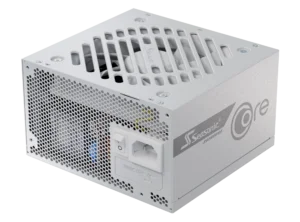
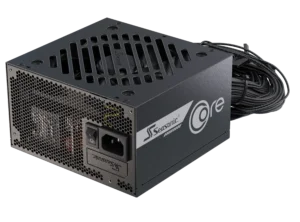
For hybrid cooling, what matters is the reduction in thermal resistance and freer airflow. These improvements help lower internal temperatures and reduce reliance on the fan. Support for Hybrid Mode does not in itself confirm the use of this design in all generations of PRIME, VERTEX, and FOCUS. Our FOCUS GX ATX 3.1 combines OptiSink™ with Digital Hybrid Fan Control. OptiSink™ can also work with other fan-control systems. Our CORE GX ATX 3.1 pairs this thermal design with S2FC Smart and Silent Fan Control, illustrating that OptiSink™ is not limited to hybrid power supplies.
Internal components and Hybrid Mode
Internal components influence Hybrid Mode through the heat generated during power conversion. Electrical losses in rectifiers, MOSFETs, and other power components contribute to the heat that the cooling system must dissipate. Temperature monitoring helps the fan controller determine when additional airflow is needed.
Component layout and thermal connections affect how efficiently that heat is removed. For a broader explanation of the electronics themselves, see our guide to power electronics in power supplies.
Fluid Dynamic Bearing (FDB) fans
An FDB is a hydrodynamic bearing that operates using lubricant, which forms a thin layer between the bearing surfaces and prevents direct contact between them. As the shaft rotates, the lubricant flows through the grooves in the bearing sleeve, and its dynamic pressure increases as the speed increases. This helps keep the surfaces separated and maintains smooth rotation.
The distinctive herringbone-shaped grooves guide the lubricant and help prevent it from leaking out. Lubrication reduces friction and vibration, while the bearing design contributes to quieter operation and the fan’s longevity. These properties make FDB suitable for power supplies where acoustic comfort is important both under light load and after switching to active cooling.
The hydrodynamic bearing and Hybrid Mode serve different purposes, which is important to distinguish. The bearing affects the fan’s mechanical operation, while the controller determines when to start it and how to regulate its speed. When the fan is stopped, it produces no rotational noise. When it starts, its mechanics and operating speed become important. Therefore, these solutions complement each other.
The fan size depends on the power supply generation. For example, the FOCUS PLUS Platinum was equipped with a 120-millimeter FDB fan, while the FOCUS GX ATX 3.1 uses a 135-millimeter fan.
Three fan operation modes
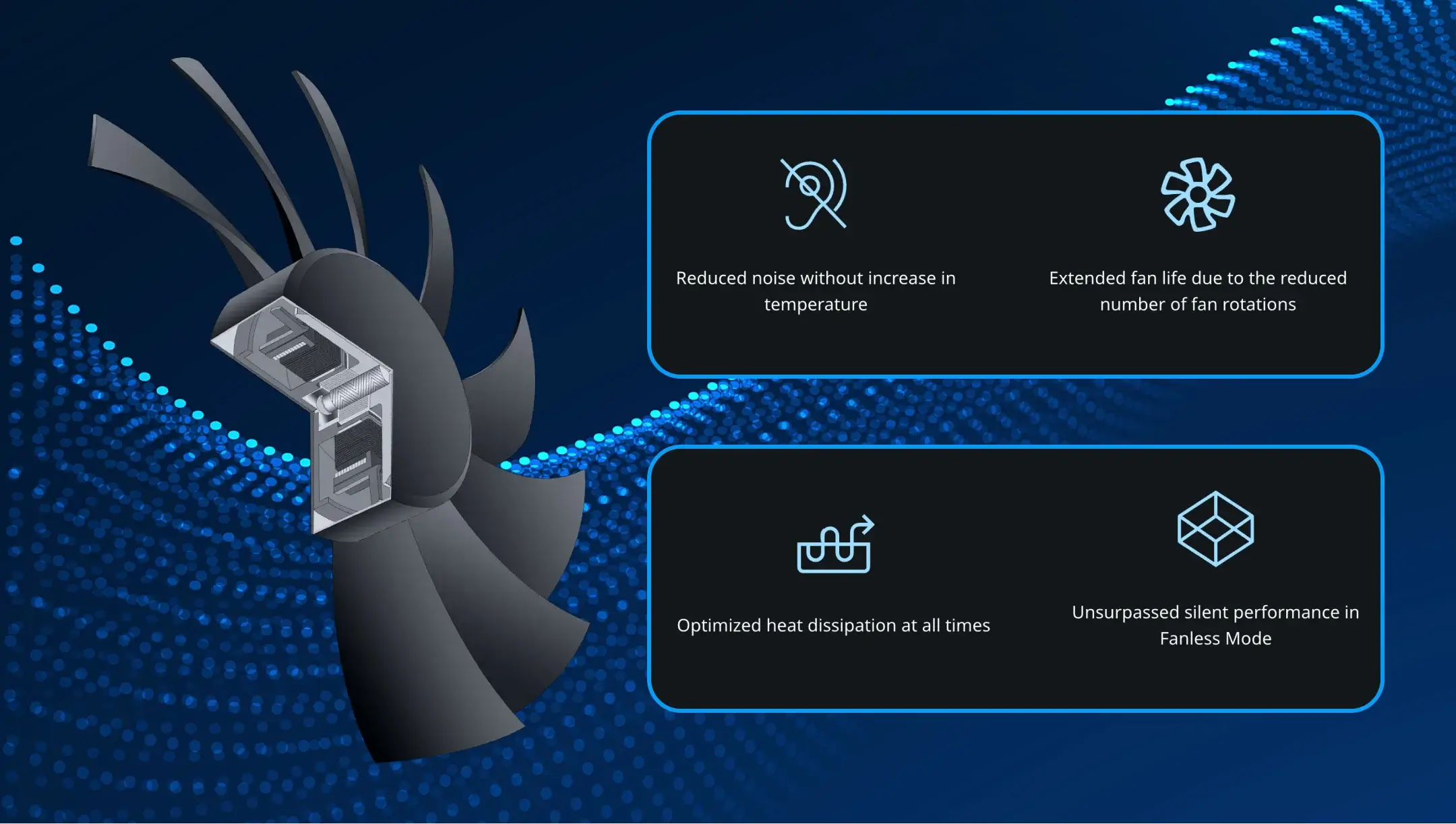
There are three operating states in the Hybrid Silent Fan Control: Fanless Mode, Silent Mode, and Cooling Mode. These states illustrate how cooling adjusts based on the power supply’s needs. These are automatic operating states, so the user does not need to switch between them each time a program is launched.
In Fanless Mode, the fan does not spin. The power supply continues to operate, and its design dissipates heat without forced airflow from the fan. This mode is possible under appropriate load and temperature conditions. For example, the previous generation of FOCUS GX supports passive operation up to approximately 30% load.
In Silent Mode, the fan runs but at a low speed. This is an intermediate state where forced airflow is needed, but intense cooling is not required. The name “Silent” refers to a quiet mode, not the complete absence of any sounds from the entire computer.
In Cooling Mode, airflow increases in response to rising cooling demands. This mode is relevant during prolonged, resource-intensive tasks that increase the load and heat generated by the unit. Launching a game does not automatically cause the fan to run at maximum speed; operating conditions remain the determining factor.
In addition to these three modes, models with a button offer a choice between Hybrid and Normal. In Normal mode, the fan runs even under light load. Thus, this switch determines whether the fan can be stopped, rather than manually setting one of the three speeds.
Digital fan control, PWM, and hysteresis
Digital control adjusts cooling based on the power supply’s operating conditions. Our FOCUS GX ATX 3.1 v5 uses OptiSilent™, which monitors load and temperature in real time and uses PWM speed control. At low loads, the fan can remain off, and active cooling resumes when needed.
PWM (pulse-width modulation) regulates fan speed by varying the duty cycle of a control signal. This allows the controller to adjust the fan’s rotational speed according to cooling demand.
In the FOCUS GX ATX 3.1 v5, we introduced an improved PWM control IC that made it possible to use a fan variant with a lower starting speed. The earlier FOCUS GX ATX 3.0 and the v5 use different fan variants, so the lower starting speed is enabled by the combination of the updated control IC and a suitable fan. The table below compares measured fan speeds for the two models.
| 模型 | Approximate fan speed at 40% load and 230 V AC |
|---|---|
| FOCUS GX -850 ATX 3.0 | 700 RPM |
| FOCUS GX-850 ATX 3.1 v5 | 400 RPM |
Both values were measured at 40% of rated load and a 230 V AC input. These figures represent specific operating points; actual fan speed varies with load, temperature, and operating conditions.
Hysteresis prevents frequent switching or speed changes around control thresholds. In fan on/off control, it separates the conditions for starting and stopping. After the fan starts, a slight reduction in load or temperature does not immediately switch it off; the conditions for returning to passive cooling must first be met. PWM provides precise speed regulation, while hysteresis helps prevent repeated changes near a control boundary.
A practical consequence of this principle is that the fan may continue to run for a certain period after the load decreases. The controller must take into account the conditions for returning to passive mode, not just the fact that a resource-intensive program has been closed.
Our Digital Hybrid Fan Control charts are for reference only: actual fan behavior depends on ambient temperature, system configuration, and airflow.
Thermal protection and load thresholds in hybrid-mode power supplies
Fan control and overheating protection serve different functions. Hybrid Mode determines when fan operation is needed during normal operation. OTP, or Over Temperature Protection, responds to excessive heat and automatically shuts down the power supply. Sensors monitor critical components; once OTP is triggered, the PSU can only be restarted after it has cooled sufficiently.
Actual behavior is also influenced by ambient air temperature and system ventilation. Therefore, the load chart should be read in conjunction with our accompanying notes. The passive mode limit, the permissible operating temperature, and the OTP trigger conditions should not be confused. They describe different device characteristics.
For example, the FOCUS GX ATX 3.1 has an operating temperature range of 0 to 50°C. This does not mean that the fan starts at 50°C or that the protection mechanism triggers at exactly this temperature. This series also includes OCP, OPP, OVP, UVP, and SCP. They complement OTP by monitoring other undesirable electrical conditions, but they do not replace proper case ventilation or the correct selection of a power supply unit’s wattage.
Seasonic series supporting hybrid mode: PRIME, VERTEX, and FOCUS.
Hybrid cooling control is available in various generations of the PRIME, VERTEX, and FOCUS PSU Series.
| 海韵 PSU系列 | 描述 |
|---|---|
| PRIME TX ATX 3.1 PRIME PX ATX 3.1 | These models use Digital Hybrid Fan Control. The fan can stop under certain conditions and start up when active cooling is needed. |
| VERTEX PX ATX 3.1 VERTEX GX ATX 3.1 | They support hybrid mode and are equipped with 135 mm FDB fans. |
| FOCUS PX FOCUS GX | The 2019 models feature 120 mm FDB fans and the Hybrid Silent Fan Control system, which allows the fans to stop at loads of up to approximately 30%. |
| FOCUS GX ATX 3.1 (2024) | It combines Digital Hybrid Fan Control with the OptiSink™ thermal design. The PSU uses a 135 mm FDB fan. |
| FOCUS PX ATX 3.1 v5 FOCUS GX ATX 3.1 v5 | OptiSilent™ is used to support hybrid work. The system takes load and temperature into account, controlling the fan according to cooling needs. |
The fan start-up thresholds and other parameters should be checked on the page for the specific model; they are not the same for all units in the same series.
Benefits of hybrid mode for gaming and office PCs
For an office computer, the main advantage of hybrid mode is the ability to eliminate power supply fan noise during periods of low load. Working with text documents, email, or simple web pages can create the right conditions for this, provided the configuration and temperature allow it. This offers a practical benefit for a quiet workspace, as one source of noise is temporarily disabled. At the same time, the PC’s other fans may continue to run.
In a gaming PC, the load varies across different usage scenarios. Hybrid mode for gaming sessions allows for quiet operation during lighter tasks and activates active cooling when the PSU heats up more significantly. During a long, demanding gaming session, the fan may run continuously. This is a normal part of the cooling algorithm. The advantage lies in adapting to conditions, not in promising passive mode throughout any given gaming session.
For both scenarios, it’s important to select the correct power rating, ensure proper ventilation, and verify connection compatibility. Hybrid mode controls fan behavior, while the PSU’s ability to power the CPU and GPU is determined by its electrical specifications. Therefore, it is a valuable component of a comfortable PC experience, along with an appropriate configuration of the entire system.
结论
Our hybrid power supplies combine passive operation with active cooling. Their advantage for the user is that the fan’s operation is coordinated with the need for heat dissipation. When conditions allow, the fan stops. When the need increases, it kicks in to provide cooling. This approach helps maintain a quiet computing environment for a computer that performs tasks of varying complexity throughout the day.
The result depends on a combination of engineering solutions. The FDB bearing helps reduce friction and vibration during rotation. Digital control adjusts fan speed to match operating conditions, while hysteresis prevents frequent switching or speed changes around control thresholds.
When choosing between PRIME, VERTEX, and FOCUS, start by considering the specific needs of your PC. Its power requirements, connectivity, and available space for the PSU. Next, compare the fan type, hybrid mode support, and installation requirements. The estimated percentage of passive operation is meaningful only in conjunction with the model description and operating conditions.
And a couple of words on usage. Keep the ventilation openings clear and follow our recommendations. If the power supply shuts down due to a protective function, this requires investigating the cause rather than changing settings just to reduce noise. In a properly configured system, hybrid cooling reduces unnecessary fan operation and ensures active heat dissipation from components when needed.